 It is a scary society we live in
where some people are not free to enjoy their culture without fear of getting
the cops called on them. Maybe the food they brought to lunch does not smell
desirable enough to Lauren in accounting, or your hair is not “neat enough” for
your manager Bill, or your accent is too thick for the conversation on the
subway. Situations like this are a constant reminder for people of color that
they are forced to assimilate as to not offend the white people they are seated
next to.This one time my younger brother
and his friends stole a man’s racist confederate flag. I was tasked with taking
him to the man’s house to apologies, and of course the man had to come up to me
sitting patiently waiting and start making conversation. I began by explaining
that I’m sorry my brother did this of course, but your flag is inherently
racist and frankly un-American. He obviously disagreed and said that “the Puerto
Ricans fly that flag as disrespect to Americans.” What that man failed to
realize was that the Puerto Rican flag is an American flag and in no way
disrespectful, just an expression of their culture. I should send that man this
video. We clearly did not see eye to
eye, and I’m not admitting anything but if that flag goes missing again, this
time they won’t be able to connect my brother to it.
It is a scary society we live in
where some people are not free to enjoy their culture without fear of getting
the cops called on them. Maybe the food they brought to lunch does not smell
desirable enough to Lauren in accounting, or your hair is not “neat enough” for
your manager Bill, or your accent is too thick for the conversation on the
subway. Situations like this are a constant reminder for people of color that
they are forced to assimilate as to not offend the white people they are seated
next to.This one time my younger brother
and his friends stole a man’s racist confederate flag. I was tasked with taking
him to the man’s house to apologies, and of course the man had to come up to me
sitting patiently waiting and start making conversation. I began by explaining
that I’m sorry my brother did this of course, but your flag is inherently
racist and frankly un-American. He obviously disagreed and said that “the Puerto
Ricans fly that flag as disrespect to Americans.” What that man failed to
realize was that the Puerto Rican flag is an American flag and in no way
disrespectful, just an expression of their culture. I should send that man this
video. We clearly did not see eye to
eye, and I’m not admitting anything but if that flag goes missing again, this
time they won’t be able to connect my brother to it.
In education, especially inside a classroom,
students should feel free to express their joy in different cultures. We as
educators have a duty to the students to not tolerate differences but celebrate
them. As a white man, I have done the work to reprogram my thoughts to allow
for a more compassionate approach to teaching. Gary
and Stockman suggest that “rather than merely consuming content, students
who learn in compassionate classrooms produce it as well” (99). It my biggest
fear in my classroom to put a lot of effort into a lesson or activity for my
students to be unengaged and really not enjoying it at all. By leading with
compassion and understanding, I believe that students will want to be engaged
as a way to express their cultures and beliefs.
There are many different methods to
compassionate cultural teaching and they all offer different positives and negatives.
A staple in class instruction is simply conversations. Sometimes, teacher lead,
small group, and one on one. I obviously look forward to being a teacher in the
classic sense, standing in front of the class talking, mostly because I like the
way I sound, but also because I think I have a lot of good things to say! This
allows for students to focus on one thing and really absorb what I’m trying to
teach. I agree with Kay
when they said, “This teacher-student-teacher rhythm has been ingrained enough
to make any disruption in the pattern feel monumental” (63). Although this
method works, it almost eliminates the students voice and creativity, which is
linked to their cultural expression and identity. I find that teachers often
forget that students have ideas and probably know how they are to learn best
and they “rarely as students how they feel about the different methods we
faithfully employ” (63). I think it would be beneficial during the school year
to take a sample group of students and do almost a focus group for lessons and
activities. That way I could do a better job planning my lessons, and thus allowing
me to be more sensitive to cultures and identities. Small groups were one of my
favorite learning styles growing up. I think I really shine in a smaller group;
I find that it’s the perfect size to show off my knowledge without feeling like
I have to battle to get my words out. In these small groups, it is less teacher
supervised which allows students to “freely deal in stereotypes and half logic”
(72-3) which is a great place to be in as a student who wants to learn and
grow.
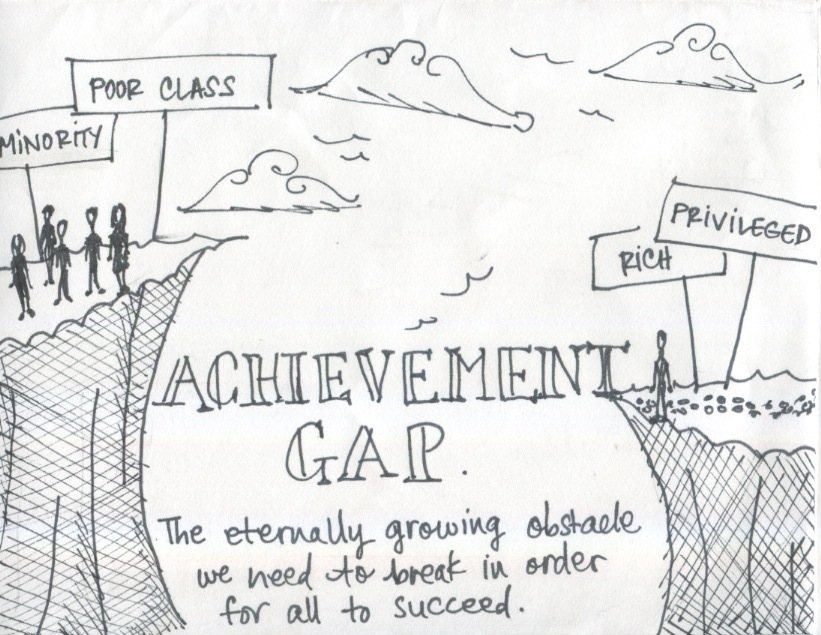 A pressing issue that is always
involved when thinking about student’s growth and learning is the achievement
gap. This I feel is unavoidable, but we must do our best to fight it. How are
we as educators to change a system that is flawed and designed only for
students to are granted a certain level of privilege. This system is still controlled
by the same people who created it and it is clear that it was not made for
people of color or of differing abilities. Winn
and Johnson say, “Remnants of classist and racist theories continue to
linger in the policies and pedagogies that shape schooling for minority and
poor children” (13). This is so true considering schooling has changed very
little while history is changing rapidly. More and more students are attending school
and seeking higher education, and more often than not, education may be the only
way “out” of the situation they were born into. It is crucial that we see all
students, regardless of their varying abilities. It is important that we purposely
create lessons that are easily changed to fit the needs to all students we are tasks
to educate. I still feel hopeless at times because these systems are so deeply
ingrained in the system that I don’t know how easy it is to change from the
inside like this, especially speaking as someone who hasn’t even begun teaching
yet.
A pressing issue that is always
involved when thinking about student’s growth and learning is the achievement
gap. This I feel is unavoidable, but we must do our best to fight it. How are
we as educators to change a system that is flawed and designed only for
students to are granted a certain level of privilege. This system is still controlled
by the same people who created it and it is clear that it was not made for
people of color or of differing abilities. Winn
and Johnson say, “Remnants of classist and racist theories continue to
linger in the policies and pedagogies that shape schooling for minority and
poor children” (13). This is so true considering schooling has changed very
little while history is changing rapidly. More and more students are attending school
and seeking higher education, and more often than not, education may be the only
way “out” of the situation they were born into. It is crucial that we see all
students, regardless of their varying abilities. It is important that we purposely
create lessons that are easily changed to fit the needs to all students we are tasks
to educate. I still feel hopeless at times because these systems are so deeply
ingrained in the system that I don’t know how easy it is to change from the
inside like this, especially speaking as someone who hasn’t even begun teaching
yet. 
Hi Skylar! I really appreciated your story at the beginning because it gave me a real-world connection to the issues that could arise people were not informed about culture and the meaning. As I read on, I enjoyed the sentence where you mentioned that as educators we should “not tolerate differences, but celebrate them.” I completely agree with this statement! I might add that we should also first acknowledge that every student is different, and just that acknowledgement makes us culturally informed educators. It also models to the students how they should view everyone in the world. That not everyone is the same and not everyone has the same cultural values or looks like you. This could also break that idea that everyone should assimilate to the dominant white culture. Secondly, I wanted to comment on the teacher-student relationship you mentioned. I feel like this communication and collaboration is crucial to having an open and compassionate classroom. I can see your view that it could eliminate the students’ voice; however, I think that if this communication is infinite, then the student will always have a chance to speak. I don’t think it is strictly teacher-student-teacher, with the teacher having the last word, but rather a cycle that keeps on happening and evolving. Just something to think about and consider! The final point I want to touch upon is the achievement gap. You discuss how more and more students are seeking higher education, which made me think of a new point on the achievement gap that connects to privilege. If more students are attending college, they are probably from different socioeconomic backgrounds, which means there is probably going to be an achievement gap between college students. Doesn’t this once again put students from upper class families at an advantage, since they are more prepared for higher education? And doesn’t this also mean that the achievement gap will just keep on following those same students from different socioeconomic background? How can people ever “get out” of their living situation, if they already start at a disadvantage?
ReplyDeleteHi Skylar!
ReplyDeleteI definitely agree that it is scary that we live in a society where people are not free to express their culture without fear of ridicule, prejudice, or persecution. Thank you for sharing your story about your brother. It is examples like these that show how intolerant people are to others who are not like them and ignorant about cultures that our not their own. Like you, I find myself thinking about this as a white educator and how I can help cultivate a classroom where cultural and personal expression are celebrated. I do believe that culturally relevant pedagogy is vital to this! I also think it can help systematically change inequity in education. At the end of your post you stated, "I still feel hopeless at times because these systems are so deeply ingrained in the system that I don’t know how easy it is to change from the inside like this." I believe that the more we talk about the achievement gap and what causes it, how we as white teachers can help dismantle white dominate culture instead of perpetrating it, actively engage in culturally relevant pedagogy, and as a community work towards a common goal of educational equality, I think that is how we will change the system. The system is deeply broken; I know this first hand as a secondary teacher. But I've learned to focus on my locus of control and that is helping to guide my students to success both personally and academically. If more current or future teachers implemented culturally relevant pedagogy and engaged in conversations like this, think about how many classrooms could be transformed! So, as a future teacher what will you do within your locus of control? How will you implement culturally relevant pedagogy in several aspects of your classroom?
Hi Skylar! Thanks for sharing your story about your brother, I hope that experience showed you how people can act with culture that is not their own specifically. I have to laugh on when you stated you don't agree on just standing in front of the class and teaching students that way but you love your voice and voicing your opinion. I love that!!!! I can picture you standing in front of your students rocking the stage and being a cool teacher! Don't have the fear of you taking all this time into a lesson plan that students might not enjoy because as long as you know your students inside and out, you will know what is best for your students and what you need to successfully teach them.
ReplyDelete